

By Steve Rhode, founder of GetOutOfDebt.org — helping people escape debt since 1994.
This morning, a retiree reached out through my free chat on GetOutOfDebt.org. Living on Social Security. Owes $27,000 to the IRS from three years of past taxes. Already got burned by a tax relief company that took their money and did nothing.
They asked me: What are my options?
I knew immediately what every other advisor — every CPA, every tax relief company, every Google result — had already told them: payment plan, Currently Not Collectible status, Offer in Compromise.
All real options. All incomplete.
Because nobody had mentioned the one thing that could actually end the debt.
The Thing Nobody Tells You About Tax Debt
Here is what almost every accountant, every tax relief company, every Google result, and every well-meaning friend will tell you about IRS debt:
You can't get rid of it. You can only manage it.
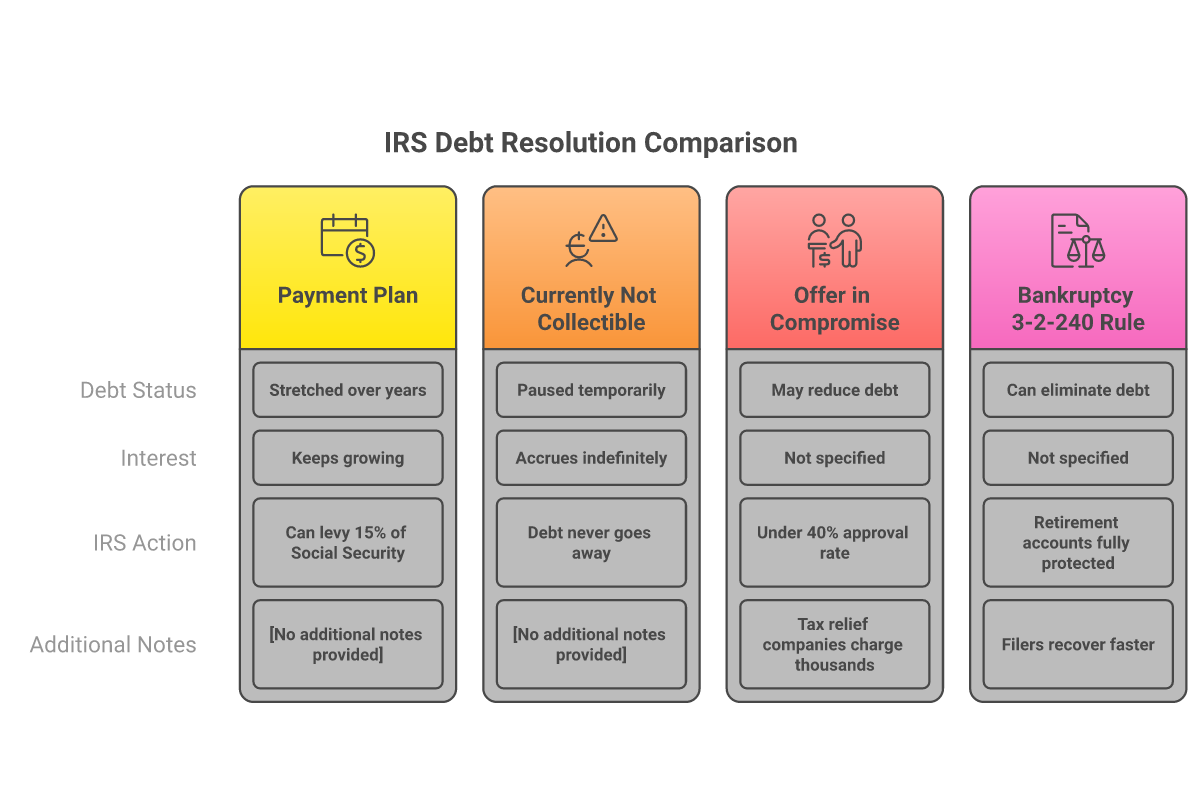
Payment plans stretch it out. Currently Not Collectible pauses it. An Offer in Compromise might reduce it — if you're one of the fewer than 40% who get approved.
But none of these eliminate it. The debt sits there. Interest accrues. The IRS can levy up to 15% of your Social Security. And every one of these "solutions" keeps you in the system, paying, negotiating, waiting.
Here is what almost nobody tells you:
Certain income tax debts can be completely discharged in bankruptcy.
Not managed. Not reduced. Not paused. Eliminated.
The 3-2-240 Rule
There are three conditions. If your tax debt meets all three, it may be dischargeable:
The 3-Year Rule. The tax return was due at least three years ago — including any extensions you filed.
The 2-Year Rule. You actually filed the return at least two years ago. (Unfiled returns don't qualify — but once you file them, the clock starts.)
The 240-Day Rule. The IRS assessed the tax at least 240 days before you file for bankruptcy.
That's it. Three timing tests. If your income tax debt passes all three, a bankruptcy court can discharge it the same way it discharges credit card debt.
This isn't a loophole. It's 26 U.S.C. §523(a)(1) — a provision that has been in the bankruptcy code for decades. It applies to income taxes — federal and state. Not payroll taxes, not fraud penalties. But for the vast majority of people who simply owe back income taxes? The math works.
The retiree I spoke with this morning owed taxes from three years of past filings. There's a very real chance some or all of that $27,000 qualifies.
Why Nobody Mentions This
This is where it gets interesting.
Tax relief companies — the ones running ads on every podcast and late-night TV slot — charge you a percentage of what you owe or a flat fee of $5,000–$8,000. Their product is negotiating with the IRS on your behalf: payment plans, Offers in Compromise, penalty abatement. If your debt gets discharged in bankruptcy, they don't have a product to sell you. A bankruptcy attorney charges a flat fee — typically $1,500–$3,000 — and the debt is gone. The tax relief company was going to charge you the same amount to manage a debt that could have been eliminated. They're not lying to you. They're just not mentioning the option that puts them out of a job.
CPAs and enrolled agents are tax professionals, not bankruptcy attorneys. Most of them genuinely don't know the 3-2-240 rule exists. It's bankruptcy law, not tax law. It wasn't part of their training. So they recommend what they know: payment plans and Offers in Compromise.
The IRS itself isn't going to volunteer this. Their job is collection, not discharge. They'll happily set you up with a payment plan. They won't suggest you talk to a bankruptcy attorney.
And bankruptcy attorneys? Most people never call one about tax debt. Because they "know" — from the same cultural narrative that tells them bankruptcy is shameful — that taxes can't be discharged.
Except they can.
The credit card industry spent over $100 million lobbying to pass the 2005 bankruptcy reform act. They embedded the word "Abuse" into the title of a federal law. Collection industry training manuals from 1946 — I'm not making this up — document deliberate strategies to engineer shame around debt relief.
David Graeber traced this back 3,500 years. In the earliest Vedic texts, the word for debt was synonymous with guilt and sin. To be in debt was to have "a weight placed on you by Death." The language hasn't changed much. We still say people are "burdened" by debt, that they need to "pay their dues," that they should feel "guilty."
The shame is ancient. The math is modern. And the math says: a retiree on Social Security who can't pay a penny doesn't need a payment plan. They might need a discharge.
What This Means for You
I'm not telling you to file bankruptcy. I'm telling you something more important: the option exists, and the people you're asking for help have financial reasons not to mention it.
If you owe the IRS for taxes from returns that were due more than three years ago — especially if you've already filed those returns — you owe yourself a one-hour consultation with a bankruptcy attorney. Not a tax relief company. Not a CPA. A bankruptcy attorney.
That consultation will cost you $0–$300. The tax relief company was going to charge you thousands.
The Federal Reserve studied bankruptcy filers and found they experienced a "sharp boost" in credit scores and had less financial stress than people who were insolvent but didn't file. The peer-reviewed research shows reduced mortality, protected retirement savings, and a 95% discharge rate.
Your retirement accounts — 401(k), IRA, pension — are fully protected in bankruptcy. The 2005 law that made bankruptcy harder to file also added a $1 million retirement exemption. Nobody mentions that part either.
If you're not sure where you stand, my free Find Your Path tool takes two minutes and will tell you which options fit your specific situation — including whether bankruptcy is worth exploring.
I filed bankruptcy in 1990. My tax situation was different, but the shame was the same. Nobody told me it was an option until I was desperate enough to ask the right person. I've spent 30 years since trying to be that person for everyone else.
Your creditors — including the IRS — are institutions making calculated business decisions. You should be making one too.
Steve
P.S. — If you know someone grinding under IRS debt who doesn't know this option exists, forward this to them. The information is free. The relief companies charging $5,000 to not tell them this are not.
Should I hire a CPA to do my taxes next year if my student loans are discharged? My bankruptcy attorney dragged his feet and had to reopen the BK before filing the adversary action in 2026.