

Dad Joke
What’s a vampire’s favorite fruit?
A blood orange.
Now Let’s Make Your Money Smile
Your phone was probably not listening. Somebody just got fined for saying it was.
You know the feeling. You mention a mattress out loud, and by lunchtime your phone is full of mattress ads. Everybody I know has a version of that story.
Yesterday the FTC finalized orders requiring three companies to pay $930,000 over a product marketed as exactly that. CMG Media Corporation — it does business as Cox Media Group — pays $880,000, and two marketing firms it worked with, MindSift and 1010 Digital Works, pay $25,000 each. The FTC says they told advertisers they had an algorithm that listened in on conversations picked up by smart devices, and that consumers had agreed to it.
Then comes the sentence worth reading twice, in the FTC’s own words: “Contrary to these companies’ claims, however, the marketing service wasn’t based on voice data, and consumers hadn’t opted into this service.”
Straight about the limits: three firms, one product. This is not a finding that no app anywhere ever listens, and the $930,000 reimburses the advertisers who bought the service, not you.
Here’s why it’s about your money and not just your nerves. If you believe the microphone did it, you whisper. You cover a camera. You feel watched, and nothing changes. The FTC’s file says what the service wasn’t running on; it doesn’t say what it was. The boring answer nobody makes a documentary about is information about you being collected, bought and sold, entirely legally, while you sit there eyeing your phone.
Today, ten minutes. Here are the actual taps, because “check your privacy settings” is useless advice without them. All of this is free and none of it breaks anything.
On an iPhone, two separate switches, and most people have never touched either:
Settings → Privacy & Security → Tracking — turn off Allow Apps to Request to Track. That cuts off apps following you into other companies’ apps and websites.
Settings → Privacy & Security → Apple Advertising — turn off Personalized Ads. That’s Apple’s own targeting, and it’s a different switch. (Apple’s instructions)
On an Android, one place: Settings → Privacy → Ads → Delete advertising ID. On older versions it’s Settings → Privacy → Advanced → Ads. Deleting the ID is stronger than resetting it. (Google’s instructions)
Android menus move around between manufacturers, so if Privacy isn’t there, search the Settings app for “Ads” — that finds it on every phone I’ve tried it on. And straight with you: this doesn’t stop the ads, and it doesn’t reach the data already sold. It stops your phone handing over a fresh permanent ID to everyone who asks. That’s the mechanism that’s actually there.
⚠ Forward this one to the person who tapes over their laptop camera.
They have been fighting the wrong thing for years, and they’d want to know. Ten minutes in their phone settings does more than the tape ever did, and nobody is going to tell them that but you.
A credit bureau just said the quiet part out loud.
The entire sales pitch for debt settlement rests on one idea: it’s the softer option, the one that spares your credit compared to the nuclear option of bankruptcy.
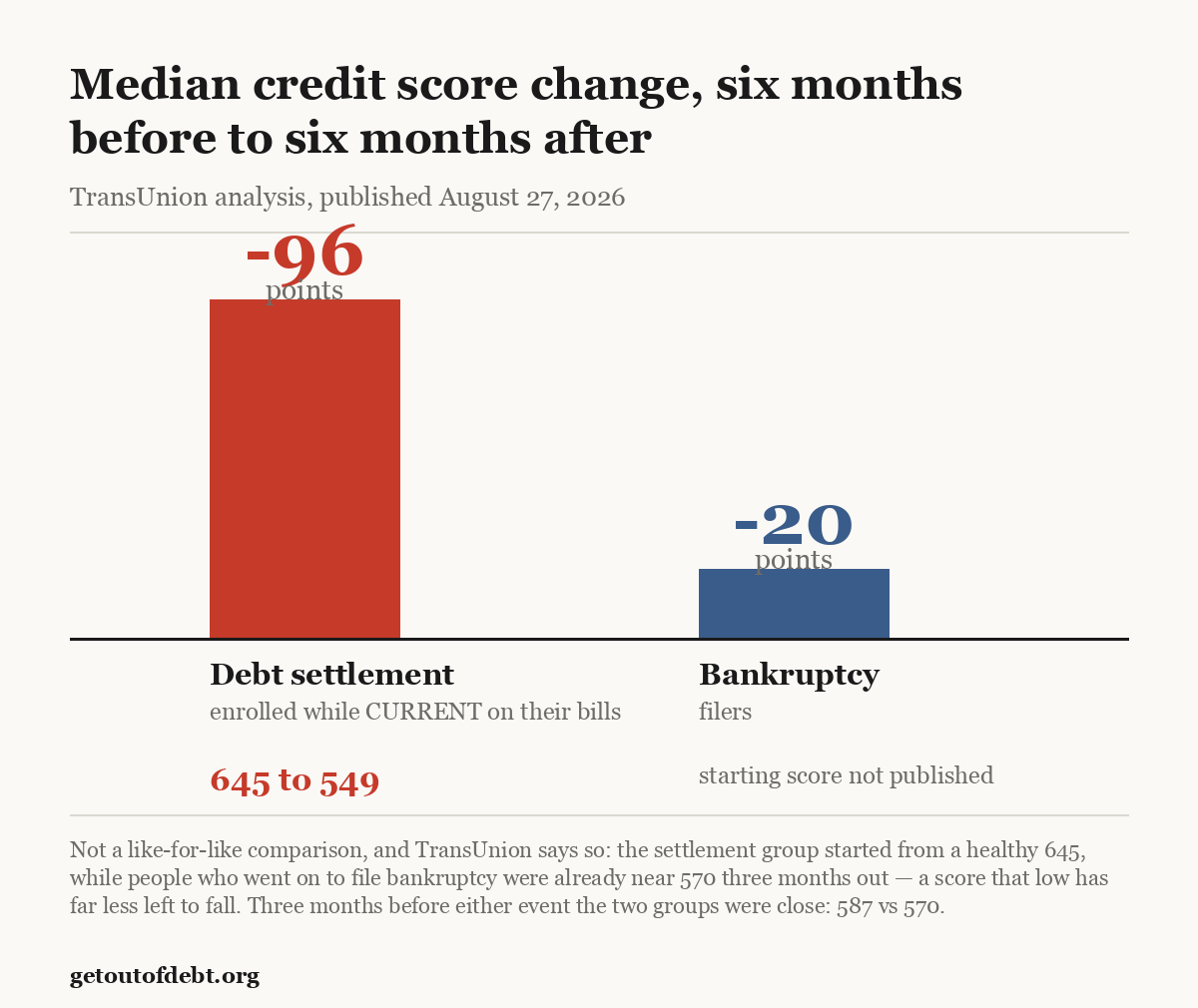
Yesterday TransUnion published an analysis that points the other way. Among people who enrolled in third-party debt settlement while they were still current on their bills, the median credit score fell 96 points — 645 six months before enrolling, down to 549 six months after. Bankruptcy filers, over the identical six-month window, fell 20 points.
That is one of the three big credit bureaus, using its own data, saying settlement did more damage to those people’s scores than bankruptcy did.
And this is the number I keep going back to: nearly half of everyone who enrolled in debt settlement was current on their bills when they signed up. Not behind. Not in collections. Paying.
Now let me hand you the strongest argument against my own reading, because it is a real one and you deserve it before you decide what to think — the two groups are not like for like: the 96-point group started from a healthy 645, while the people who ended up filing bankruptcy had a median around 570 three months out, and a score already that low has far less left to fall. Twenty points isn’t a measure of how gentle bankruptcy is; it’s a measure of damage that had already happened before anyone started the clock.
Here’s what survives that objection. Three months before either event, the two groups looked alike — the settlement group’s median VantageScore 4.0 was 587, against 570 for the people who went on to file. If anything the settlement group was slightly healthier. Six months later it was the settlement group that had fallen further and faster.
Two honest limits, and I’d rather you heard them from me. TransUnion (NYSE: TRU) sells risk-scoring products to lenders, so on credit scores it is both a legitimate source and an interested one — hold those two facts at the same time. And per its own release it published no sample size, nothing on fees, nothing on lawsuits, and nothing on how many people actually finish these programs.
I ran a credit counseling organization. I filed bankruptcy myself, in 1990. I have spent thirty-odd years listening to companies describe, with a straight face, what their program will do to somebody’s credit. This is the first time a bureau has put its own numbers next to the claim.
If somebody is pitching you settlement today: ask them, in writing, what happens to your credit score in the first six months — and then read the numbers before you make another payment.
So what does work? We went and looked, and the answer is uncomfortable for the whole industry.
Knowing settlement is worse than advertised only gets you halfway. The question people actually ask me is “then what?” — so I put the research together across more than twenty peer-reviewed studies, and the finding is consistent: for people who are genuinely insolvent, bankruptcy gets them further ahead, faster, for less.
Further ahead. The strongest study here is Dobbie and Song in the American Economic Review. Because bankruptcy judges are assigned at random, it works like a real experiment rather than a survey — you can compare people granted Chapter 13 protection against people denied it, who were otherwise alike. Those granted protection earned $5,562 more a year, and their five-year mortality was 30% lower. Not 30% lower than the general population — 30% lower than people in the same situation who were turned down.
Faster. A Chapter 7 discharge takes four to six months, and about 95% of cases get one. A debt management plan or a settlement program takes three to five years, and fewer people finish. Even Chapter 13, the slow version of bankruptcy, completes at roughly double the rate of a DMP.
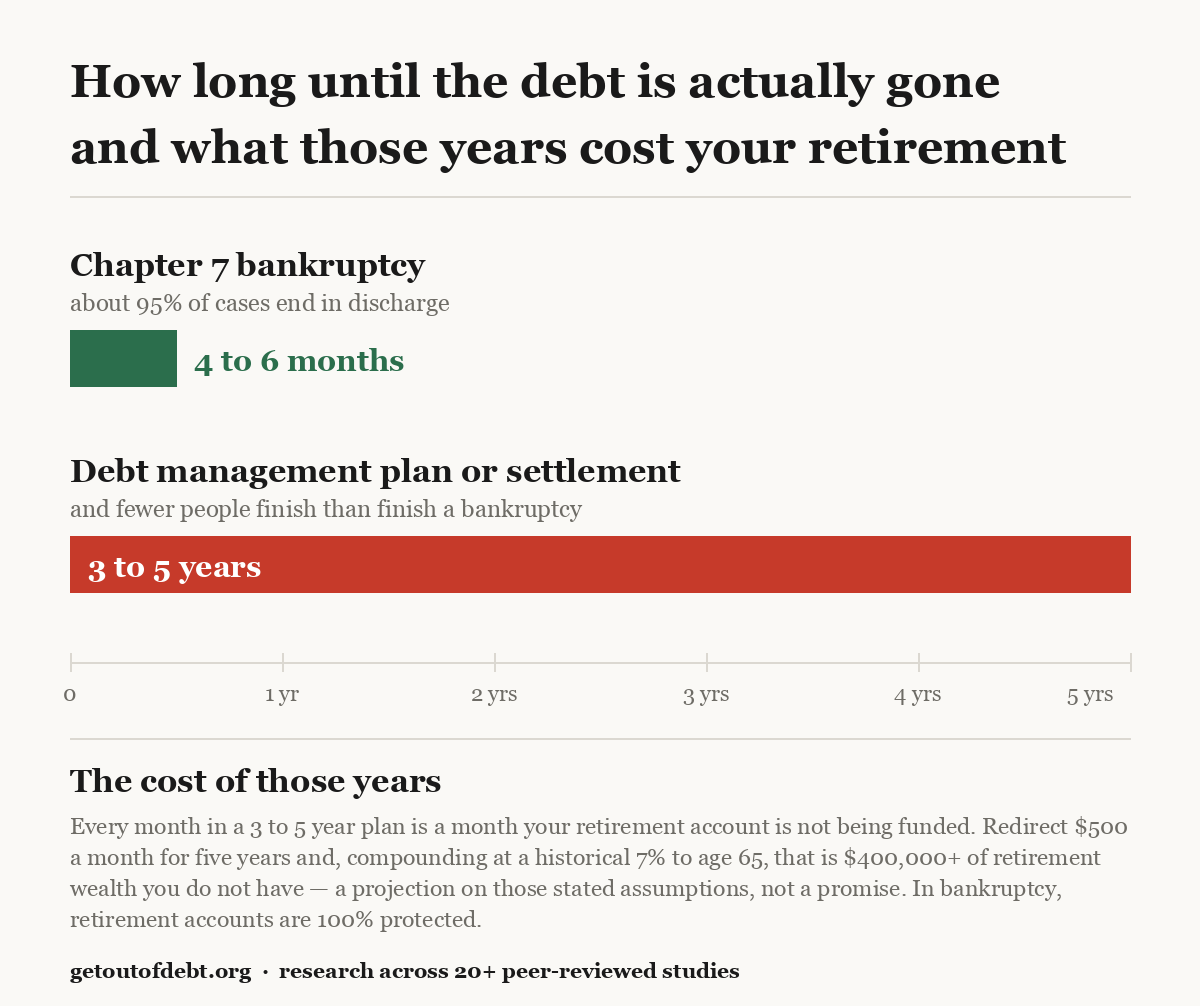
For less. This is the cost nobody puts on the sales sheet: those three to five years are years your retirement account is empty. Redirect $500 a month away from a 401(k) for five years and, compounding at a historical 7% to age 65, you can be out $400,000+ in retirement wealth — that’s a projection on stated assumptions, not a promise, and the assumptions are the point. In bankruptcy, retirement accounts are 100% protected. You don’t spend them, because you’re not asked to.
And the credit myth dies here too: low-score filers gained a median 69 points in the first month after filing.
Two things I won’t oversell. This is for people who are genuinely insolvent — bankruptcy is a legal tool with real consequences, not a life hack, and if you can pay your debts on your current income you are a different case entirely. And I have skin in this: I filed in 1990, and I ran a credit counseling organization that sold the other option. That’s exactly why I went looking at the research instead of trusting my own memory of it.
⚠ Forward this to anyone you know who is enrolled in a debt settlement program right now — or about to be.
Nearly half of the people in these programs were current on their bills when they signed up, which means somebody talked them into it while they were still paying. If that’s your brother, your neighbour, your coworker, they are making payments this month on a promise a credit bureau just contradicted.
A telemarketer can buy every do not call number in America for $23,425
The FTC set next year’s prices this week. From October 1 it’s $85 per area code, and $23,425 buys the whole country. The first five area codes are free, and some charities and political callers get the entire list for nothing.
Read that again, because it rearranges what the registry is. It was never a wall. It’s a list callers pay to read.
So why register? Because of what it does after the call. Under 47 U.S.C. § 227(c)(5), somebody who gets more than one call in a 12-month period from the same outfit, in violation of the do-not-call rules, can sue in state court for their actual loss or up to $500 per call, whichever is greater — and if a court finds the violation was willful or knowing, it may triple that.
I have never sued a debt collector myself. Plenty of my clients over the years did, and won.
The honest other half, because I’d rather you heard it from me: it’s up to $500, not a guaranteed $500. It takes more than one call from the same company. The caller has a defense if it can show it had real procedures in place and this one slipped through. And those exempt charities and political callers aren’t violating anything when they ring.
Today, two minutes: register your number free at donotcall.gov. Then keep a note on your phone — date, time, number, what they were selling. That note is the whole difference between an annoying afternoon and a file.
A computer crashed in 2020. Somebody is still carrying the bill.
This one arrived looking like a government contract dispute, which is exactly why it’s worth reading twice. On Wednesday Maryland’s attorney general sued UnitedHealth Group and Optum over the software that ran Maryland Medicaid’s behavioral health program from 2019 to 2024. Allegations only — no court has found liability, and both companies will get their say.
The headline number is the state’s: a $126.9 million contract, with the suit asking for up to triple that, roughly $380 million. That isn’t the part that stopped me.
This is. The state says the system crashed on its first day and had to be taken offline for eight months in 2020 — a program covering mental health and substance abuse care for 1.5 million people. And among the specific allegations: the software denied legitimate claims, paid providers the wrong amounts, and left hospitals without receipts.
Now think about where that lands. A behavioral health claim wrongly denied doesn’t evaporate. It becomes a bill. The bill becomes a collections account. And the person holding it has no earthly way of knowing the reason was a contractor’s software rather than their own coverage — so they assume it’s theirs, and they either pay it or carry it.
I have watched people make payments for years on medical debt that was never validly theirs. The bill arrives with no explanation attached, and an unexplained bill is very hard to argue with.
If this is you: a Maryland mental health or substance abuse bill from 2019 to 2024, sitting in collections. This filing is not proof your bill is wrong. It is a good reason to make them prove it’s right — send a debt validation letter before you pay another dollar. Ours is free and takes a few minutes.
Money you might actually be owed: $100, no receipts
If you got a data breach notice from Equinox — the gyms, not Equifax the credit bureau — about the April 29, 2024 breach, there’s a $685,000 settlement open now. It’s $100 with no documentation required, up to $5,000 if you have receipts for real losses, plus three years of credit monitoring. Claims close October 23, 2026; the approval hearing is November 12. Equinox has not admitted doing anything wrong.
Dig out the notice if you think one came. A hundred dollars for a form is a good hourly rate.
What I published yesterday
They Said a Debt Collector Can Sue Me Wherever They Want. Federal Law Says Otherwise.
A Sheriff Served Me a Writ of Execution. Here’s What to Do Right Now.
One more thing
The longer version — deep dives, full case write-ups — is the Weekday Briefing. This one stays short on purpose.
And if the phone-listening thing surprised you, it’ll surprise whoever you tell it to.
Nothing here is legal or financial advice. I don’t sell debt relief, I take no referral fees from debt companies, and I don’t know your situation. What I have is thirty-some years of watching how this plays out.
Everything I asked of you today is free: a question put in writing before you sign, a settings menu, a registry, a letter that makes a collector prove the debt is yours. That’s the pattern I keep seeing after all these years — the moves that genuinely change somebody’s position are almost never the dramatic ones. They’re small, free, slightly boring, and they were sitting there available the whole time. Most people just never got told.
Now you have been. Have a good weekend.
Back Monday.
— Steve
Bonus Section
A few places I actually use, and what I get out of telling you. Each one shows a plain link and my referral link. If you use mine, the company may hand us both a small bonus. The plain link goes to exactly the same place — it just pays me nothing, and you nothing. Use whichever you like; genuinely, it’s your call.
I’ve also listed places I like that pay me nothing at all, so you can see the difference.
Cash that actually earns something
Betterment — their Cash Reserve account is the closest thing here to a plain high-yield savings account. (my referral link)
Robinhood’s cash sweep pays competitively too. The good rate sits behind their paid Gold tier — I pay for it myself — so on a small balance the subscription can eat the gain. It’s under Investing below. Do the arithmetic before you subscribe.
And one where nobody pays anybody: TreasuryDirect is the government’s own site. You buy Treasury bills straight from the Treasury with no broker in the middle — $100 minimum, in $100 increments, terms from four weeks out to a year. There is no app, no bonus and no referral link in existence for it. I mention it because for money you know you won’t touch for a few months, it’s usually the honest number the others have to beat.
Saving without having to think about it
Acorns — rounds up your spare change and invests it automatically. I pay for it, and the reason is simple: it saves money I’d otherwise spend without noticing. (my referral link)
And the version that costs nobody anything, me included: a standing transfer out of checking on payday, at the bank you already have. Acorns works because it moves the money before you notice it; a transfer you set once and forget does the same thing. If you’d rather not open another account, do that instead — I’d genuinely rather you saved something than used my link.
Investing
Robinhood — the platform I run my own experiment on. Uninvested cash is swept to FDIC-insured program banks, so it doubles as a cash account. The competitive rate requires their paid Gold subscription, which I pay for myself — worth it at my balance, but do the arithmetic on yours. And note Robinhood doesn’t pay that interest itself; the program banks do. (my referral link)
And three I recommend on merit, where I get nothing at all: Vanguard for low-cost index funds, Schwab for a full-service brokerage, and American Century — I was a happy customer there for decades.
Rates and terms move, and each of these has its own conditions. Go look at today’s numbers before you move a dollar.
A free conversation about your situation
Damon Day is an independent debt coach, and my co-host on Get Out of Debt Guy — you can also hear us on Spotify. I want you to know that before you decide anything. I receive no payment for this referral.
The consultation is free. The only time money changes hands is if you decide you want to hire him as a consultant. Go to DamonDay.com and schedule — he doesn’t cold-call anybody, and neither do I.
Or ask me, anonymously
Ask Steve — free, private, and I’m not selling anything. No account, no email, no sales pitch at the end of it.