

By Steve Rhode, founder of GetOutOfDebt.org — helping people escape debt since 1994.
I want to tell you about a washing machine.
In 2018, the government put tariffs on imported washing machines. Prices went up 12%. Dryer prices went up 12% too — even though dryers weren't subject to tariffs. Manufacturers figured if everyone's confused about what costs what, they could raise prices on both.
Economists at the University of Chicago tracked it. The tariffs created 1,800 American jobs. They also cost American consumers $1.5 billion. The Treasury collected $82 million.
That's $820,000 per job. Paid by you.
And here's the part that matters for what I'm about to tell you: when those tariff protections were reduced, prices came back down. The artificial pressure disappeared when the artificial policy disappeared.
Remember that. It's the most important thing in this entire email.
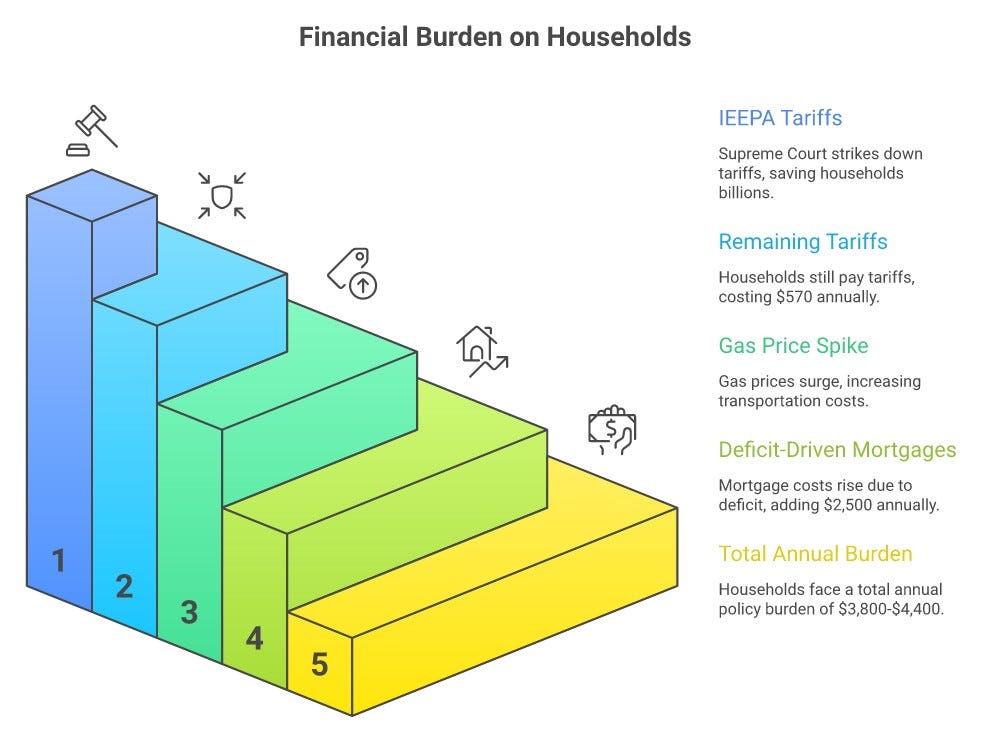
On February 20, 2026, the Supreme Court ruled 6-3 that the president had no legal authority to impose tariffs using the International Emergency Economic Powers Act. Chief Justice Roberts wrote that tariffs are "a very clear branch of the taxing power" reserved for Congress. No president had used IEEPA for tariffs in the law's nearly 50-year history.
By the time the court struck them down, those tariffs had extracted $164.7 billion from American consumers and businesses. That's roughly $500 million a day.
The New York Federal Reserve found that 90% of those costs were paid by Americans — not by foreign exporters.
Let me say that differently: the government collected $164.7 billion from you and your neighbors for something the Supreme Court said it had no right to do.
Jeremy Siegel, a Wharton finance professor, went on CNBC and said: "This is the biggest policy mistake in 95 years. This is a self-inflicted wound. It's an unforced error — did not have to happen."
Nobel Prize-winning economist Joseph Stiglitz put a number on it: "The average family is paying somewhere between $1,000 and $1,700 in extra money because of the tariffs. The tariffs are paid by Americans. They're not paid by the foreigners."
Morningstar called it "a self-inflicted economic catastrophe."
Self-inflicted. That's the word economists across the political spectrum keep using. Not recession. Not downturn. Not cycle. Self-inflicted.
I'm not going to tell you what to think about the politics. That's not my job, and it's never been what I do. But after 30 years of helping people in debt, I've learned to tell the difference between financial pain that comes from life happening and financial pain that someone else manufactured. And right now, a lot of what's hurting you was manufactured.
Here's the math the Tax Foundation found when they analyzed barcode-level retail data: clothing went up 17.5 percentage points above pre-tariff trends. Building materials, 10.5 points. Coffee and tea, 10 points. Furniture, 7.4 points.
That's not inflation. Inflation is when an economy overheats and prices drift upward. This was a policy surcharge on the things you buy every week.
And the people who could least afford it got hit the hardest. The Yale Budget Lab found that the bottom 10% of earners paid 0.8% of their after-tax income in tariff costs. The top 10% paid 0.3%. The poor were hit nearly three times harder as a share of income.
That's what a regressive tax looks like. Same math as a flat sales tax on groceries — it hits the family earning $35,000 harder than the family earning $350,000.
Now here's where it gets ugly.
The government started issuing refund checks to importers. Makes sense — the tariffs were illegal, so the money comes back. But the importers collected those tariffs from you. Through higher prices. And some of the biggest companies in the world are trying to pocket both the refund and the price increases.
The Amazon lawsuit, filed May 15, alleges that Amazon raised prices on 1,200 low-cost goods by 5.2% during the tariff period — while Walmart was cutting comparable items by nearly 2%. After the Supreme Court ruling, Amazon reportedly chose not to seek refunds or return money to customers. The suit alleges this was to "curry favor" with the White House, which had pressured Amazon not to even display tariff costs to shoppers.
The Nike lawsuit says Nike raised shoe prices $5–$10 and apparel $2–$10, paid roughly $1 billion in tariff duties, and is now positioned to collect government refunds while returning nothing to customers.
Similar suits have been filed against Costco, FedEx, Shein, Temu, and Lululemon.
Read that again: the companies that raised your prices to cover tariffs that were ruled unconstitutional are now getting refund checks from the government and keeping both the refund and your money.
That is not inflation. That is extraction.
And then there's the gas pump.
Gas was $2.81 per gallon in January — the lowest since 2021. As of this week, it's $4.56. That's a 53% increase in about 12 weeks, driven primarily by the Iran conflict and the closure of the Strait of Hormuz.
I'll be honest: whether the Iran conflict was an avoidable policy choice is a legitimate debate, and I'm not the one to settle it. But the math on your gas bill is not debatable. The average household is paying an additional $297 in fuel costs so far this year. Projections say $870 by end of summer.
That's real money leaving your checking account every week. And it's on top of the tariff costs.
Add it up — and this is assembled from the Yale Budget Lab, the Tax Foundation, and Yale's deficit research — and the total estimated annual policy burden on a typical household is somewhere between $3,800 and $4,400.
That's not "the economy." That's a policy tax.
I want you to sit with something for a moment.
Fifty-five percent of Americans now say their financial situation is getting worse. That's a record high — matching Great Recession levels. Twenty-eight percent can't make minimum credit card payments, up 11 points since 2021.
Some of that is life. Some of it is the economy doing what economies do. But a meaningful chunk of it was manufactured by decisions that courts have ruled were illegal, that economists called unnecessary, and that history tells us will reverse when the policy changes.
This is exactly what happened with Smoot-Hawley in 1930. Tariffs went to 45%. International trade collapsed by 65%. When the policy was reversed through trade agreements, tariffs eventually fell below 5% and trade recovered.
It's what happened with those washing machines in 2018.
The pattern is clear: policy creates the pressure. Policy reversal removes it.
And that pattern is the most important thing I can tell you right now. Because it means this: if your financial stress is partly caused by artificial policy pressure, then making permanent financial decisions to solve a temporary problem is the worst thing you can do.
Don't cash out your retirement. Don't take on high-interest debt to cover grocery increases that will normalize. Don't panic-sell investments. Temporary pressure requires temporary solutions — not permanent damage to your future.
I wrote the full breakdown — with the specific lawsuit links, the product-by-product price data, and what to actually do about all of this — on GetOutOfDebt.org today.
If you bought from Amazon, Nike, or Costco during the tariff period, there are class actions you'll want to bookmark. The claims process hasn't opened yet, but it will.
If the math was already broken before tariffs and gas prices made everything harder — if you were carrying debt that was unmanageable before any of this hit — talk to Damon Day for a free phone call. He’ll help you see the full picture without trying to sell you anything.
And please share this with someone who's been blaming themselves for being squeezed. Because some of what they're absorbing right now didn't have to happen. Knowing that doesn't fix the math, but it might fix the shame. And shame is the thing that makes people do permanent damage trying to solve temporary problems.
This is what 30 years of watching people navigate debt has taught me: the worst financial decisions happen when temporary problems feel permanent. Some of what's squeezing you right now is real and lasting. But a lot of it is artificial — created by decisions that courts, economists, and history all say didn't need to happen.
Take my perspective as one input. You're the only one who knows your full situation. But please — don't burn down your future to pay for someone else's mistake.
Steve
P.S. If someone you know just said "I don't know how we're going to make it this summer" — send them this. Not because I have all the answers, but because knowing the pressure is artificial changes what you do next.
yourmoneysteve.substack.com