

By Steve Rhode, founder of GetOutOfDebt.org — helping people escape debt since 1994.
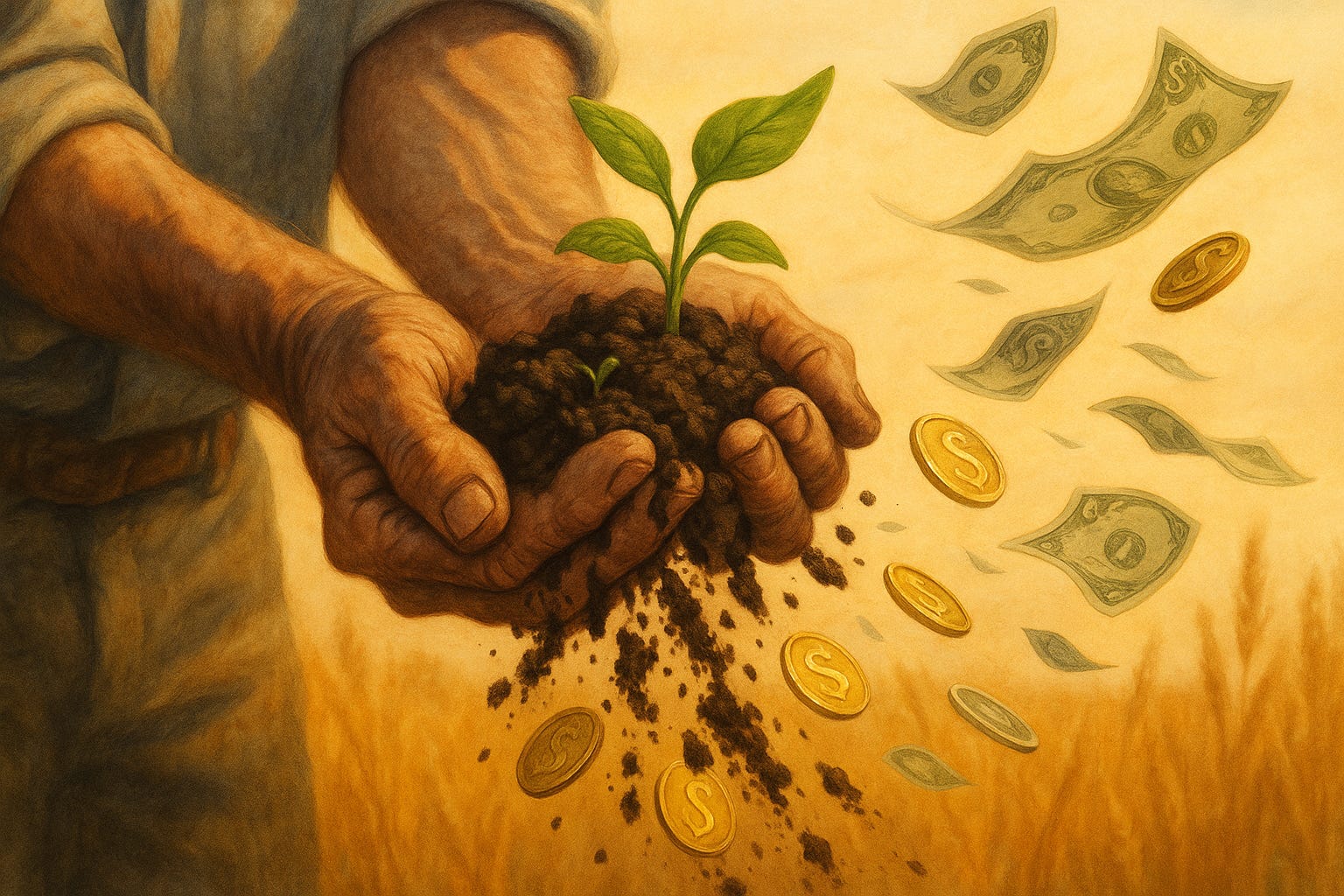
Beth Ford runs Land O'Lakes — a farmer-owned cooperative whose network touches half the harvested acres in America. Last week, she described farmers calling her in tears.
People whose families have worked the same land for four generations, saying: "I'm going to be the one that couldn't make it."
I hear those exact words every day. Different people, different debt, same shame. The farmer losing the family land. The parent who can't explain the credit card balance. The retiree watching the numbers not work. All of them convinced it's their fault.
It's not.
The number that should stop you cold
The median American farm — the one right in the middle — lost $1,830 last year. Negative. The typical farm in America does not make money from farming.
I want you to sit with that for a second, because it changes everything about how you think about your food.
Ninety percent of family farms and ranches rely on off-farm income just to survive. The farmer growing your wheat is probably also working a second job to keep the lights on. Less than 5% of farms are profitable. And farm bankruptcies jumped 46% in 2025 — 315 Chapter 12 filings, with the Midwest up 70% and Wisconsin up 700%.
Total farm debt? Heading toward a record $624.7 billion in 2026. Interest expenses: a record $33 billion. Farmers are taking out 40% more operating loans than last year — and those loans are 30% larger.
The math is broken. And I can tell you exactly when I've seen this pattern before: every single time I've sat across from someone at their kitchen table, watching them realize the debt got bigger while they were trying to make it smaller.
What broke the math
It wasn't one thing. It was everything, all at once.
The inputs got more expensive. Since 2020: interest costs up 71%. Labor up 47%. Fertilizer up 37%. Chemicals up 25%. Seeds up 18%. Tariffs raised fertilizer costs $100 per ton and made steel parts for tractors more expensive. The tools you need to farm cost more — and the markets you used to sell to closed.
The labor disappeared. Two-thirds of U.S. agricultural workers are noncitizen immigrants. Immigration restrictions created staffing gaps so severe that produce rots in the field because there's nobody to pick it.
The safety net got thinner. USDA programs designed for exactly this kind of downturn have been reduced at exactly the moment they're needed most.
And the people selling seeds don't have competition. Four companies — Bayer, Corteva, Syngenta, and BASF — control 60% of the global commercial seed market, 75% of plant breeding research, and 76% of agrochemical sales. In U.S. corn and soybeans, two of them hold 75-80% of the market. That's a textbook duopoly. Corteva raised seed prices 4-6% last year and grew royalty income by 40%.
The FTC sued two of those companies in 2022 for running illegal "pay-to-block" programs that prevented generic pesticides from reaching farmers even after patents expired. The lawsuit is still active.
John Deere and one competitor control 90% of the large tractor market. Deere paid $99 million in a settlement this year for restricting farmers from repairing their own equipment.
This is the modern company store. You can't farm without seeds, chemicals, and equipment. A handful of corporations control all three. And they're raising prices while their customers go bankrupt.
Follow the money
Here's the part that made me write this.
While the median farmer loses money, the NCREIF Farmland Index has delivered 10.15% average annual returns since 1992. Farmland is one of the best-performing asset classes in modern history — with half the volatility of stocks. Bill Gates owns 242,000-275,000 acres. Nuveen (which manages retirement savings for teachers) controls $13.1 billion across 3 million acres. Private equity investment in U.S. farmland doubled to $16.6 billion between 2020 and 2023.
Seventy-nine percent of all rented farmland is now owned by non-farmers. Land values hit a record $5,570 per acre in 2024. The investors earn the appreciation. The farmer pays the rent and loses money.
Four beef packers control 85% of the U.S. beef market. Five grain traders buy 87% of the corn crop. Crop producers received 2.5 cents of every food dollar last year. Less than three pennies.
Farm subsidies? The top 10% of recipients received 65% of commodity payments. The bottom 80% split 9%. Agribusiness spent $178 million lobbying in 2023 — more than defense or oil and gas.
I traced all seven groups that profit from this collapse — institutional investors, seed monopolies, the financial sector, food processors, foreign buyers, subsidy captors, and commodity speculators. Every claim is sourced from USDA data, GAO audits, FTC lawsuits, and SEC filings.
The part nobody wants to talk about
Farmers die by suicide at 3.5 times the rate of the general population. The male suicide rate among farmers: 52.1 per 100,000, compared to 32.0 for working-age men overall.
The contributing factors read like a debt counselor's intake form: falling income, rising costs, mounting debt, and the suffocating feeling that you're the one who failed.
Michigan just cut funding for its farmer suicide prevention program. Farmers now pay $150 an hour for counseling — while losing money farming. If you or someone you know is in crisis, the 988 Suicide & Crisis Lifeline is available 24/7 (call or text 988). The Farm Aid hotline at 1-800-FARM-AID connects farmers to financial and legal resources in every state.
Why I'm telling you this
I write about debt. That's what I've done for 30 years. And what's happening to American farmers is the clearest, most thoroughly documented example of how systems create debt — and then profit from it — that I've ever seen.
The farmer can't choose a different seed company (there are only two that matter). Can't choose a different equipment manufacturer (there are only two). Can't negotiate with the four companies that buy 85% of the beef. Can't compete with institutional investors paying cash for land at $5,570 an acre.
The math was broken before they planted the first seed.
And the part that connects to your life? When farmers go under, food prices rise. Food prices are projected up 3.6% in 2026. Coffee and tea already up 12%. Meat up 5%. One in four Americans are putting groceries on credit cards and carrying the balance.
The farmer at one end and the family at the checkout are caught in the same broken math. Neither one failed. The system did.
Debt is math, not morality. For the farmer losing four generations of land. For you, watching your grocery total climb. For all of us who were told this was personal
failure when it was structural design.
Steve Rhode has been helping people get out of debt since 1994. He founded one of the first nonprofit credit counseling organizations in the U.S. and has been featured in the Washington Post, New York Times, and on NBC, CBS, and NPR. Read more at GetOutOfDebt.org.
Read the full investigation on GetOutOfDebt.org:
American Farmers Are Going Broke — And It's About to Hit Your Wallet
Seven Groups Exposed Who Profit When American Farmers Go Broke — Follow the Money