
By Steve Rhode, founder of GetOutOfDebt.org — helping people escape debt since 1994.
Every year, the average American with credit card debt pays somewhere between $1,200 and $2,500 in interest alone.
Not principal. Not reducing the balance. Just the cost of having the debt.
That money goes somewhere. It funds bank shareholder dividends. It pays executive bonuses. It earns returns for investors who put capital into consumer lending products.
In other words: your interest payments are someone else's passive income.
I call this the debt tax. It's not an official term. But it should be, because it behaves exactly like a tax — you pay it whether you want to or not, it doesn't buy you anything new, and most people just accept it as a cost of modern life.
Here's what makes it worse than an actual tax: you opted into it. Which means the financial industry has done an extraordinary job convincing you this is normal.
Let me tell you how I know this personally.
In 1990, I filed for bankruptcy. My real estate business had collapsed. I had more debt than I could ever repay through conventional means.
At the time, it felt like the most shameful thing that had ever happened to me. I thought I had failed some fundamental test of adulthood.
It took years — and eventually building and running a credit counseling organization that helped tens of thousands of people — before I understood what had actually happened.
I hadn't failed a moral test. The math had broken.
Debt is what's left over when the math breaks. That's all it is. It isn't a character flaw. It isn't evidence that you're irresponsible. It's an arithmetic problem, dressed up in shame.
Here's the uncomfortable math most financial advice skips.
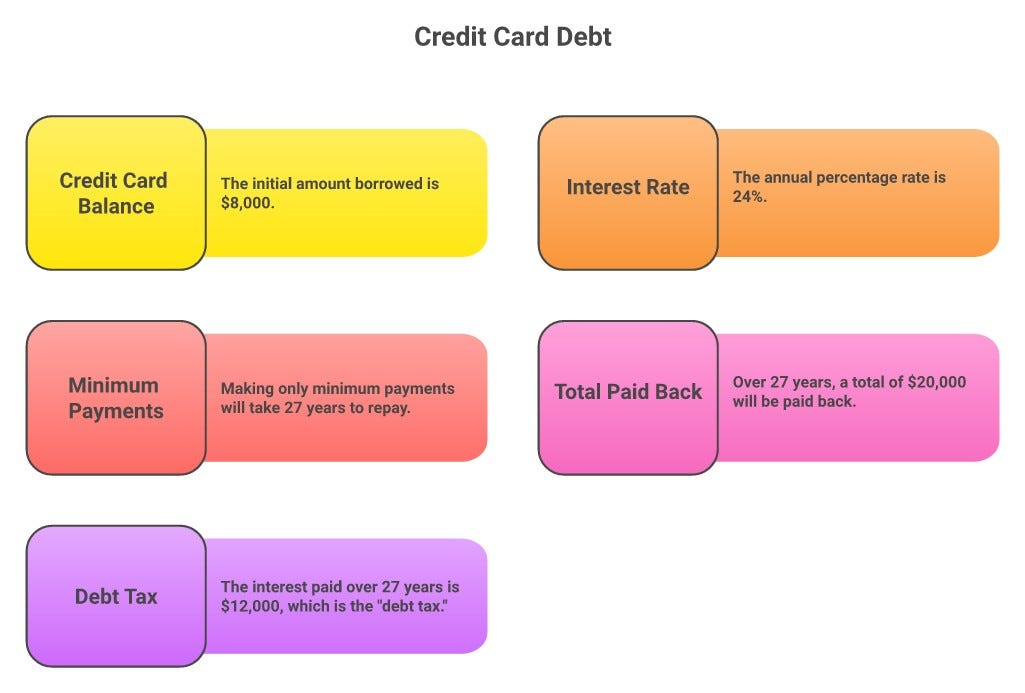
If you have $8,000 in credit card debt at 24% APR and you're making minimum payments, you'll pay that debt off in roughly 27 years. Total interest paid: about $12,000.
You borrowed $8,000. You paid back $20,000.
The extra $12,000 didn't evaporate. It transferred to someone else's balance sheet.
This is the debt tax. And unlike income tax, there's no deduction for it, no political debate about whether it's fair, and no refund if you overpaid.
So what do you do about it?
First, stop treating debt repayment as a moral exercise. "I need to pay this off because I was irresponsible" is a story that costs you money. The emotional weight slows down clear thinking.
Treat it like a business problem instead. If a line item in your business was costing you $150/month in fees and delivering nothing, you'd cut it. Same logic applies here.
Second, understand that all debt is not equal. A 6% mortgage is a different financial species than a 29% store credit card. Prioritization matters.
Third — and this is the part most advice glosses over — sometimes the fastest way out of the debt tax is a path that feels counterintuitive. Debt settlement. Bankruptcy. Negotiated payoffs. These options exist, they work for the right situations, and they're not failures. They're tools.
What this newsletter is.
Every issue, I'm going to pull back one curtain. Show you one mechanic, one industry quirk, one psychological trap that costs people money without them realizing it.
Not tips. Not budgeting templates. Not shame wrapped in cheerfulness.
Just the thing underneath the thing — explained clearly, so you can make better decisions.
You subscribed because something about your relationship with money isn't working the way you want it to. That's true for most people, at every income level.
Welcome to the conversation.
— Steve Rhode
P.S. If you're dealing with a specific debt situation right now, GetOutOfDebt.org is where I answer individual questions. I've been doing it since 2008. Free. No sales pitch.