

By Steve Rhode, founder of GetOutOfDebt.org — helping people escape debt since 1994.
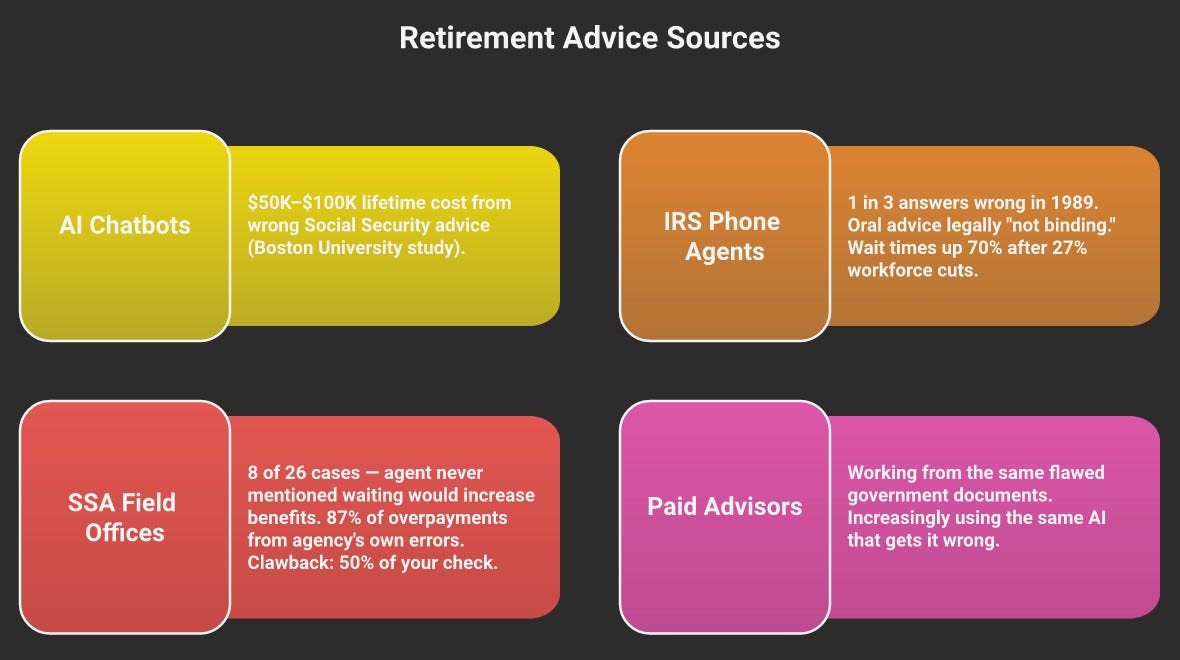
A Boston University professor just documented that AI chatbots give Social Security advice so wrong it could cost you $50,000 to $100,000 over your lifetime.
And the whole internet is outraged about it.
I'm not.
Not because it isn't a problem. It is. But because everyone's acting like there was some reliable source of advice before ChatGPT showed up. There wasn't.
The IRS has a manual. It's called the Internal Revenue Manual, Section 32.3.1.9. And in that manual, in plain English, the IRS tells you that oral advice from its own agents is — and I'm quoting — "not binding on the Service" and "cannot be relied upon as a basis for obtaining retroactive relief."
Read that again. The IRS is telling you, in writing, not to trust what the IRS tells you on the phone.
Federal tax law backs this up. IRC Section 6404(f) says you only get penalty relief for erroneous advice that was given in writing, in response to a specific written request. Phone calls don't count.
So when the Government Accountability Office tested IRS phone agents in 1989 and found that one in three answers were wrong — that wasn't a scandal to the IRS. That was working as designed. The wrong answers were your problem.
By the 2000s, it was still one in five. By 2014, the IRS stopped answering tax law questions by phone entirely — budget cuts. And this year, after a 27% workforce reduction, wait times are up 70%. The National Taxpayer Advocate found that the IRS doesn't even measure whether its agents give correct answers anymore.
They measure whether the phone gets picked up.
Not whether the answer is right.
Social Security is the same story, arguably worse.
The SSA has 2,700 rules governing your benefits. When to claim. How spousal benefits interact with your own. What happens if you work while collecting. How disability transitions to retirement. Getting any one of these wrong by a single year can cost you tens of thousands of dollars.
A 2016 GAO study sat in on 30 in-person claims at SSA field offices. In 8 of the 26 cases where waiting would have produced higher benefits, the agent never mentioned that waiting was even an option. Seven out of 18 people affected by the earnings test got incomplete information about how it worked.
But here's the part that should genuinely make you angry.
When Social Security makes a mistake — overpays you based on their wrong calculation — you have to pay it back. The SSA Inspector General found that 87% of sampled overpayments were caused by the agency's own incorrect computations. The clawback rate is up to 50% of your future benefits until it's recovered.
There is no law protecting you from Social Security's own errors. If they tell you the wrong amount and pay you too much, that is, legally, your problem.
And the SSA just went through the largest staffing cut in its history. Seven thousand workers. Wait times up to five hours. Performance metrics pulled from the public website. If you couldn't get a reliable answer before, what do you think is happening now?
So the standard advice — the one you'll hear from every personal finance outlet this week — is "hire a fee-only financial planner."
And I've given that advice myself. But I want to be honest about what it actually means.
That financial planner is working from the same government documents that the government's own agents can't interpret correctly. They're reading the same IRS code sections, the same SSA rule book with 2,700 provisions. And increasingly — and this is the part that keeps me up at night — they're using AI tools to help them analyze your situation. The same AI that Professor Kotlikoff just proved gives six-figure mistakes with a smile.
I'm not saying don't hire a professional. I'm saying stop pretending there's a simple answer.
To know whether you should claim Social Security at 62, 67, or 70, someone has to correctly interpret how dozens of interacting rules apply to your specific situation — your earnings history, your spouse's record, your health, your other income, how the earnings test works, how benefit taxation works, how Medicare premiums interact with all of it. A single wrong assumption in any one of these areas can cost tens of thousands of dollars.
And even if they get it right — how do you verify that? Who checks the checker?
I've personally lived this frustration. Years ago, dealing with the Department of Education on student loan issues, I pointed out that their process didn't match what their own manual said. Word for word, the response I got back was: "That's how we do it."
Not "you're right, we'll fix it." Not "here's why the manual doesn't apply here." Just: that's how we do it.
The manual says one thing. The agency does another. And you're supposed to navigate the gap between them on your own, on a decision worth more than most people's cars.
Where does "right" actually exist?
I've been asking myself that question for 30 years, and the honest answer is: nowhere you can find it for free, and nowhere you can verify it without significant effort.
The best I can offer — and I mean this — is a set of habits, not a destination:
Get everything in writing. From everyone. The IRS literally tells you their own phone advice is worthless. So get recommendations in writing, with reasoning attached. If a financial planner won't explain their math, they're not confident in it.
Never trust a single source. Run your Social Security question through the official calculators, a professional, and the IRS tax tools. If two of three disagree, you've found a $50,000 problem before it becomes one.
Protect what's already protected. Your 401(k) and IRA are shielded in bankruptcy. Don't let anyone — not AI, not a phone agent, not a settlement company — talk you into cashing out retirement to pay dischargeable debt. That's one area where the law IS clear.
When the stakes are high, pay for verification. Not because the professional is guaranteed to be right — but because they're the only source who'll put their analysis in writing and explain their reasoning. Ask how they arrived at their recommendation. Ask what they assumed. Ask what happens if those assumptions are wrong. A good advisor won't be offended. A bad one will.
I wrote the full breakdown with every source and citation here.
The outrage this week over AI giving wrong retirement advice is justified. But it's aimed at the wrong target.
The system for helping regular people make $100,000 decisions about their future has been broken for decades. The IRS won't stand behind what its agents say. Social Security will claw back its own mistakes from your check. The paid experts are working from the same flawed documents with the same flawed tools. And now AI has made wrong answers faster and more confident than ever.
There is no magical source of "right." There never was. The only thing that changed this week is that people finally noticed.
Steve
P.S. If someone you know is within 10 years of retirement and thinks they can just "call Social Security" to figure out their plan — send them this. They deserve to know what they're actually up against.