

By Steve Rhode, founder of GetOutOfDebt.org — helping people escape debt since 1994.
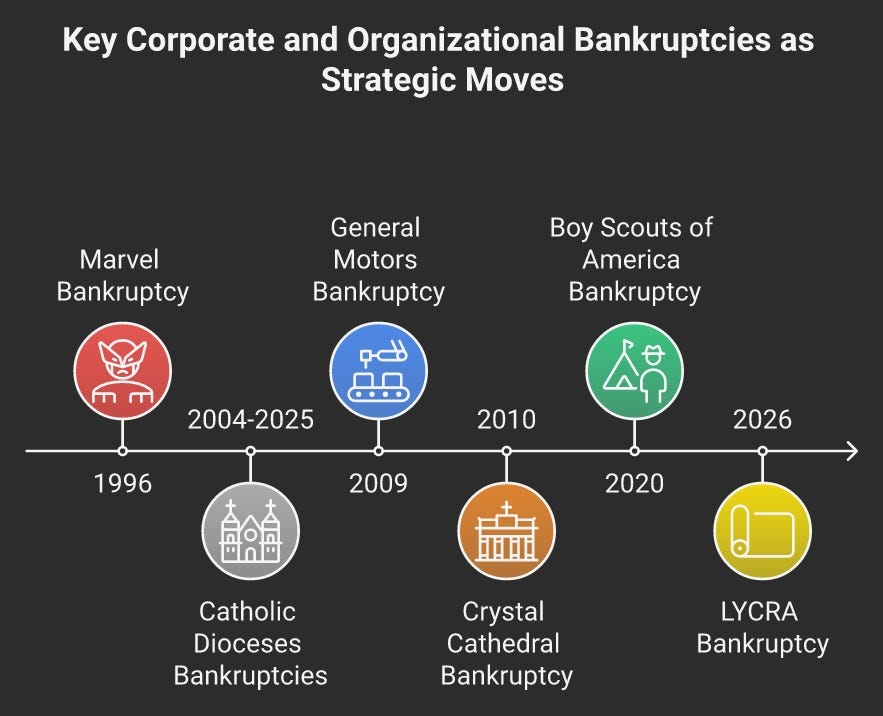
On March 17, 2026, The LYCRA Company — the people who make the Spandex in your workout clothes — filed for Chapter 11 bankruptcy to eliminate more than $1.2 billion in debt.
Their press release called it “decisive action” to “position the business for long-term financial stability and growth.” They secured $150 million in new financing. They expect to emerge in 45 days. The CEO framed it as a milestone.
When a corporation does this, the press release practically pops champagne. When you consider the exact same legal protection, people tell you it’s a moral failure.
I filed bankruptcy myself in 1990 after my real estate business collapsed. It wasn’t my proudest moment at the time. It turned out to be one of the smartest financial decisions I ever made. Watching how corporations celebrate the same tool that individuals are shamed for using has been one of the defining observations of my 30-year career in debt education.
LYCRA is not an outlier. This is a pattern.
The Hall of Fame of Corporate Bankruptcy
General Motors filed Chapter 11 in 2009 with $172 billion in debt — the second-largest industrial bankruptcy in U.S. history. The government backed their reorganization. They emerged in less than two years, re-launched on the NYSE at $33 a share, and today GM has a market cap of $73 billion. Nobody calls them irresponsible.
Marvel filed Chapter 11 in 1996 with $610 million in debt. They had to sell the rights to Spider-Man just to survive. Thirteen years later, Disney bought them for $4.3 billion. The Marvel Cinematic Universe has since grossed over $30 billion worldwide. Nobody says Marvel should have just “made a budget and stuck to it.”
American Airlines filed Chapter 11 in 2011. Merged with US Airways. Became the world’s largest airline. 2014 was their first profitable year in seven years.
Delta. United. Kodak. Texaco. Every single one used bankruptcy as a strategic financial tool. They restructured. They eliminated debt. They came back stronger. And the business press celebrated them for it.
The Churches Know Too
Here’s where it gets uncomfortable for the people who tell you bankruptcy is ungodly.
Forty-three U.S. Catholic dioceses and religious orders have filed for Chapter 11 bankruptcy protection since 2004. Not one. Not five. Forty-three. They’ve paid out nearly $4.4 billion through these proceedings. The Archdiocese of Portland was first in 2004. The Diocese of Alexandria, Louisiana filed as recently as 2024. Twelve dioceses are still in active bankruptcy proceedings right now.
The Crystal Cathedral — Robert Schuller’s megachurch, home of the “Hour of Power” broadcast — filed Chapter 11 in 2010 to restructure $43 million in debt. They eventually sold their iconic building to the Roman Catholic Diocese of Orange and emerged from bankruptcy.
The Boy Scouts of America filed Chapter 11 in 2020.
These are institutions that, in many cases, tell their congregations and members that bankruptcy is a moral failing. And then they use the exact same legal protection when their own math breaks.
Forty-three Catholic organizations have filed bankruptcy. So why are you being told it’s ungodly?
And if you want the biblical case: Why Jesus Would File for Bankruptcy.
What the Federal Reserve Actually Found
The Federal Reserve Bank of New York tracked bankruptcy filers for a decade using Equifax credit panel data. Here’s what they found:
Chapter 7 filers gained an average of 82 credit score points within months of filing — jumping from 538 to 620.
People who stayed insolvent without filing showed worse outcomes across every measure: lower credit scores, more collection actions, growing court judgments, less access to new credit.
By years 8–10, the average filer’s credit score approached 700 — near the U.S. median.
The research is unambiguous. Filing for bankruptcy produces better financial outcomes than not filing. GM knows this. LYCRA knows this. Forty-three Catholic dioceses know this.
The only people who don’t know this are the ones being told to feel ashamed.
The shame is manufactured. It’s manufactured by an industry that profits when you stay in debt longer. Credit counseling companies earn fees for every month you’re in a debt management plan. Debt settlement companies take a percentage of your enrolled balance. Collection agencies buy your debt for pennies and collect full price.
None of them want you to know that the Federal Reserve says bankruptcy filers recover faster. None of them want you to compare yourself to General Motors, or Marvel, or the Catholic Church.
Treat your finances like a boardroom, not a confessional. When the math is broken, fix the math. That’s not a moral failing. That’s what every successful corporation in history has done.
If LYCRA can call it a milestone, so can you.
Steve
P.S. I built a free tool that walks you through your actual options based on your specific situation — no sales pitch, no upsell. Take the Find Your Path quiz at GetOutOfDebt.org.