

I sometimes hesitate to tell people how much I use artificial intelligence.
Which is a strange position to be in when I use it all day, every day, and it’s become part of how I run multiple companies by myself.
I feel like a closet success story.
Say “AI” and some people picture made-up facts, lousy articles, and a threat to work they’ve spent years learning to do. I understand why. There’s plenty of evidence to support those concerns.
But I’ve also had an experience worth sharing.
Nothing I write is going to change the rotation of the earth or convince the neighbor’s dog that my front yard isn’t the best place in the world to take a dump.
But maybe we can have a conversation.
I Wasn’t Impressed Either
I’ve worked with computers since 1975. That doesn’t make me right about everything that comes next. It does mean I’ve seen a long line of advancements, disappointments, and things that were supposedly going to change everything.
When I first started using the current generation of AI tools, they got a lot wrong. The outright hallucinations were ridiculous. It was like dealing with someone who had an answer for everything and didn’t let being wrong slow them down.
There was a lot of room for improvement.
Then the tools improved, and I got better at figuring out where they helped and where they needed supervision.
I use them to explore questions, organize research, challenge ideas, and help me move projects along. Working on my own means there are limits to how much I can personally get through in a day. AI has become part of how I deal with those limits.
That doesn’t settle anyone’s concerns about jobs or how these systems were built. If you’re worried about your livelihood, my telling you that I’m getting more done probably isn’t much comfort.
Have You Seen the Internet?
One criticism of AI is that it produces things that aren’t true.
Yes. It does. Sometimes with astonishing confidence.
These systems learn from vast amounts of material, including material from the internet. Have you seen the internet? We weren’t exactly starting with a spotless collection of verified human wisdom.
That’s not an excuse. It’s a reason to check what comes back.
If I ask an AI tool something, accept the answer without checking it, and publish it under my name, I’m responsible for what I publish. “The computer told me” isn’t much of an explanation to a reader I’ve misled.
That responsibility is part of using the tool.
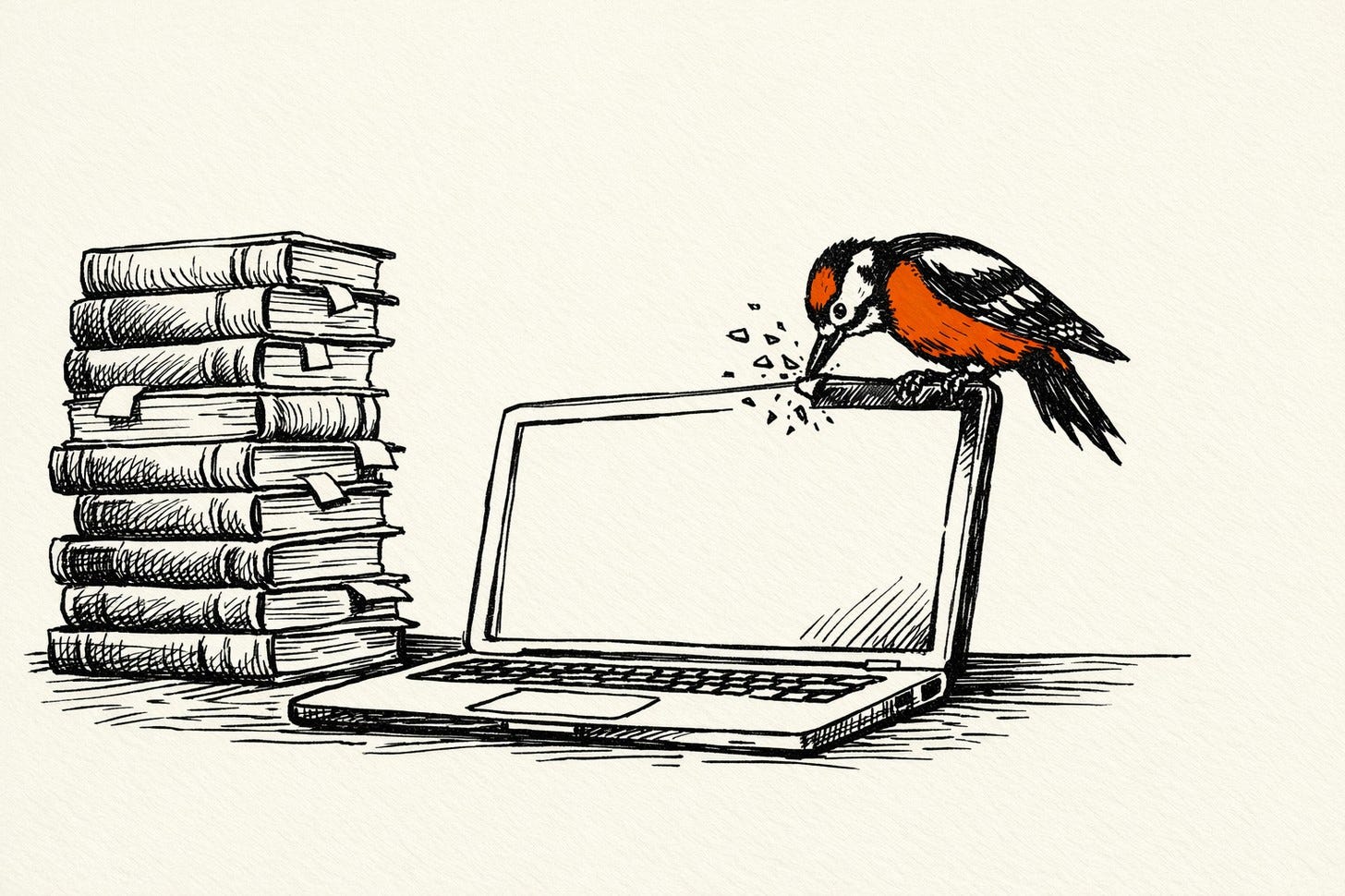
About Those Woodpeckers
Research is one area where I’ve found AI useful.
To explain how I approach it, let’s use woodpeckers. They’re pretty amazing, except when one is hammering on the side of my house. Then my appreciation of nature turns into, “Are you kidding me!”
I could open ChatGPT or another tool and type, “Tell me about woodpeckers.”
There’s nothing wrong with starting there. But if I’m researching something for an article or a script, I need to go further.
I ask for research, source links, and an explanation of where the evidence is strong or where there’s uncertainty.
Then I bring in my gang.
I’ve set up different AI agents and reviewers with different jobs. One checks factual claims. One is the contrarian, looking for holes in the argument. Another considers a different perspective and questions assumptions the others might have missed.
I want the argument challenged before I put it in front of a reader.
There’s a catch, of course. Three AI systems can agree and still be wrong. Giving one the job of fact-checker doesn’t magically make it reliable. And asking for another perspective doesn’t give a machine someone else’s lived experience.
Their reviews help identify things to investigate. The source still has to support the claim. Important facts still need checking.
That’s where my judgment comes in, and where my responsibility stays.
Why This Matters to Me
I remember what research used to involve. Going to a library, sometimes a university library. Requesting books from other libraries. Reading, taking notes, cross-checking, and following a lead that might turn out to be a dead end.
Days could become weeks.
There was satisfaction in that process. I also had questions I couldn’t pursue because I didn’t have unlimited time.
What excites me now is being able to explore more of those questions. I can get an initial view of a subject, find possible sources, and have an argument picked apart while I’m still developing it.
The checking takes work. So does deciding what matters. But I can get further into an idea before running out of hours.
For someone with more ideas than time, that’s a pretty big deal.
Getting feedback on my writing isn’t new, either. When I was younger and had an important paper to turn in, my AI engine was called Mom or Dad. As I got older, it was called Editor. And for others, I was the AI engine, under the title Ghost Writer.
This essay is mine. I asked AI to review the organization and the tone, the same way I once asked them. Love you, Mom.
So, Is It Slop?
Some of it absolutely is.
I don’t enjoy an article that wastes my time, repeats itself, or tells me something that falls apart the moment I check it. Producing a thousand more of those isn’t an accomplishment.
But I’d like to leave room for AI-made work that someone has thought about, questioned, checked, and shaped into something useful.
That’s the work I’m trying to do.
I’m enthusiastic because I keep finding uses for these tools in my own life. I’m still learning, and I still have to be willing to question what they give me.
You don’t have to share my enthusiasm. But I hope I can talk about what’s working for me without the conversation ending at “AI slop.” Maybe then I can be a little less of a closet success story.
And I’d like to hear what you’ve tried, too. Including the part where it went completely wrong. I probably have a story to match.