

By Steve Rhode, founder of GetOutOfDebt.org — helping people escape debt since 1994.
Every financial advisor in America says the same thing about Social Security: wait. Wait until 67. Better yet, 70. Bigger check. Free money. Only a fool leaves it on the table.
I took mine at 62.
Not because I didn't understand the math. Because I did — and what I found is that the math everyone quotes is built on an assumption nobody can verify: that you’ll live long enough to collect the difference.
Here’s the calculation they don’t show you.
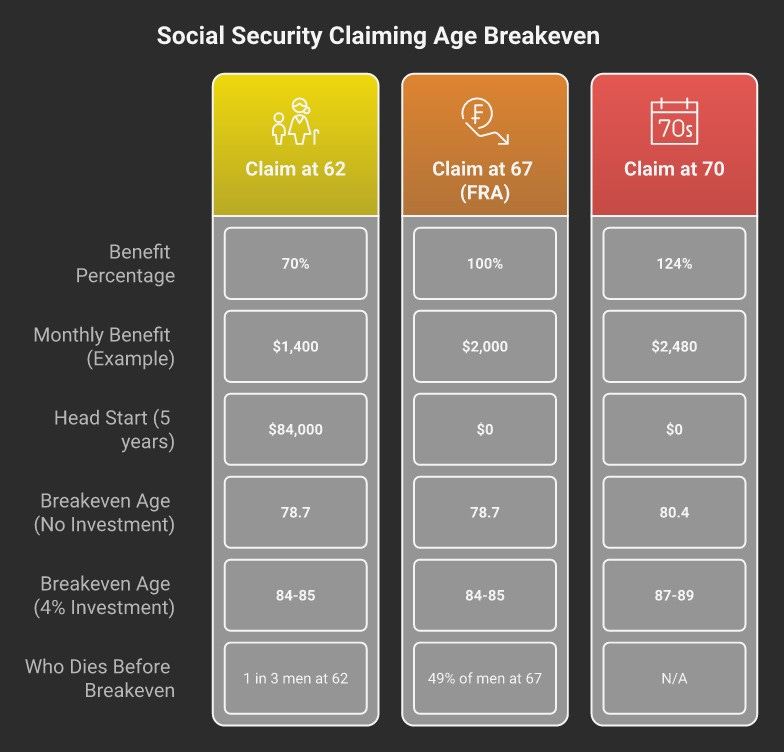
If your Full Retirement Age benefit is $2,000 a month, claiming at 62 gets you $1,400 — a 30% permanent reduction. Sounds terrible. But you collect for five extra years before the person who waited gets a single check. That’s $84,000 in your pocket before they start.
The person who waited gets $600 more per month. At that rate, it takes them 140 months — nearly 12 years — to catch up. That puts the breakeven at age 78, almost 79.
But here’s the part that changes everything: that math assumes you stuff your early checks under a mattress. If you invest them at even a modest 4% return, the breakeven pushes to age 84-85. A study in the Financial Planning Association Journal found that with realistic returns, you’d need to live to 89 for waiting from 67 to 70 to pay off.
And here’s what nobody mentions when they tell you to wait:
One-third of men who reach 62 die before age 79. Two in five die before 80. Nearly half of men at 67 die before 82. Those aren’t worst cases. Those are SSA actuarial tables — the government’s own numbers.
The Social Security Administration itself doesn’t recommend a specific claiming age. Their official position is that the benefit formula is designed to be “actuarially fair” — total lifetime benefits should be roughly equal regardless of when you claim. The agency that writes the checks says it shouldn’t matter when you start.
So where does the “always wait” advice come from?
When I became eligible, I sat down with my investment advisor and walked him through this breakeven analysis. I even laid out the case for taking it early and investing the difference — because who knows what the future will bring.
He pushed back hard. His position was essentially: trust that it will be there in eight years. He parroted back the same mantra. “You need to wait.”
No new math. No analysis of my specific situation. Just the conventional wisdom, delivered with total confidence.
And here’s the thing — I was a registered investment advisor earlier in my career. I know the models. I’ve run the numbers professionally. And even I had to fight through the noise to find my own answer.
I decided I’d rather enjoy a fuller life while I was still young enough to get around. A dollar at 63, when you can travel and stay active and get on the floor with your grandkids, is worth more than a dollar at 83. No spreadsheet captures that.
Now — I need to be honest about something. My situation made early claiming rational. I had retirement savings growing separately. Social Security wasn’t my only income. If it’s your only income source, maximizing that check matters more. If you’re the higher-earning spouse, your benefit becomes your partner’s survivor benefit — and that’s the strongest mathematical case for waiting.
But here’s what I want you to take from this:
Question the assumption. Don’t let an advisor, a website, or a rule of thumb make a $100,000 decision for you. Do the breakeven math with YOUR numbers. Factor in YOUR health, YOUR savings, YOUR plans for the next decade. Ask what the advice assumes — and what happens if those assumptions are wrong.
The “always wait” advice serves some people well. But it’s not universal truth. It’s a rule of thumb built on a zero percent return assumption and an implied promise that you’ll live into your mid-80s. For roughly one in three men, that promise doesn’t hold.
I wrote the full breakdown with every source, study, and calculation here.
My investment advisor — a professional I trust and pay — told me to wait. I was a registered investment advisor myself, and even I had to fight through the noise. That’s how deep the assumption runs.
Question authority. Stop believing common assumptions just because everyone repeats them. Ask questions. Don’t assume. Do your own math. And then make the decision that’s right for your life — not the one someone else decided was right for everyone.
Steve
P.S. If someone you know is within 10 years of retirement and thinks the answer to “when should I claim Social Security” is obvious — send them this. The math might change their mind. Or it might not. Either way, they deserve to see it before they decide.
Excellent advice!