

By Steve Rhode, founder of GetOutOfDebt.org — helping people escape debt since 1994.
I want to be honest with you about something before I say anything critical: Dave Ramsey has genuinely helped a lot of people.
His message that debt is serious, that you need a real plan, that emotional spending is often the root cause — I believe all of that. I've been saying the same things since 1994.
But after three decades of watching people try his approach, I've noticed a pattern nobody talks about. The people who fail Dave's system don't fail because they're lazy or undisciplined. They fail because his system was built for a brain they don't have.
Here's the thing Dave never asks before giving advice: How does your brain actually work around money?
Standard money advice is built for one kind of brain — neurotypical, low-stress, with intact working memory and impulse control. But there are dozens of reasons someone's brain might not fit that mold: ADHD, anxiety, financial trauma, a money personality wired more toward spending than saving, or simply the cognitive crush of being under severe financial pressure. Dave's system was never designed for any of them.
Here's what most financial advice ignores entirely: you don't need a diagnosis for this to apply to you. Research shows that financial stress alone causes measurably ADHD-like symptoms in people who are otherwise neurotypical. Your IQ drops. Your attention span shortens. Your ability to plan ahead erodes. The shame spiral that follows — I know what I should do but I can't make myself do it — makes everything worse, because shame triggers avoidance, and avoidance lets the debt grow.
Budgeting requires sustained working memory, impulse control, and consistent re-engagement over months. These are exactly the capacities that get disrupted — by ADHD, by anxiety, by trauma, by stress, by a spender's money personality in a world of temptation. 'Just make a budget' is like telling someone with a broken leg to run it off.
The fix isn't to budget harder. It's to automate the decisions the budget was meant to govern — so the right things happen whether or not your brain is cooperating that day. And it starts with understanding how your brain actually works. The Your Brain on Debt Quiz and the Money Personality Quiz are both free and take less than three minutes.
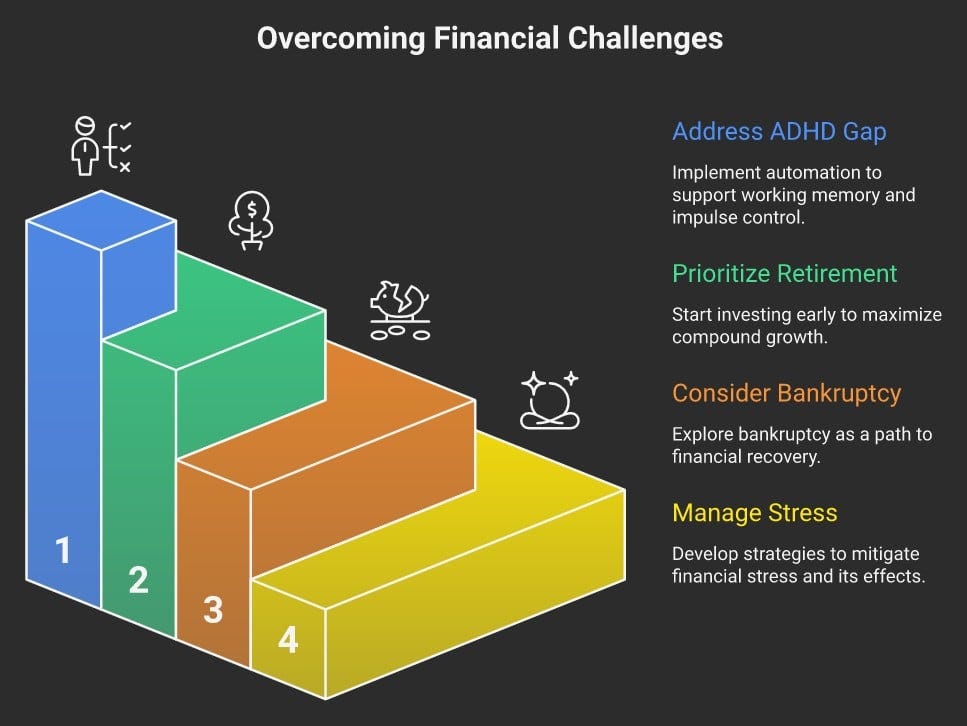
The retirement cost nobody calculates
Dave's Baby Step 2 says pay off all non-mortgage debt before seriously investing for retirement.
For a 35-year-old with $40,000 in debt, following that advice can cost over $400,000 in lost compound growth by retirement.
I ran a credit counseling organization. I watched people sacrifice five years of retirement contributions to pay down credit card debt. Their creditors got lower-interest payments. Their retirement accounts sat frozen during what should have been their highest-compounding years.
The system I ran benefited from this. I'm telling you now so you don't walk into it blind.
The part nobody says out loud
Dave Ramsey filed bankruptcy himself — in the late 1980s, after his real estate business collapsed. His own financial reset came through the very system he now discourages his listeners from using.
I'm not saying that to be snarky. I'm saying it because it reveals something important: bankruptcy is a constitutional legal tool, not a moral failure. It exists because society decided that giving people a genuine fresh start serves everyone better than decades of financial servitude.
A Federal Reserve study found that people who filed bankruptcy did better financially than similarly-situated people who didn't file. Credit scores typically recover faster after bankruptcy than after five years of minimum payments.
That's not my opinion. That's the data.
So when does Dave's approach actually work?
When your income exceeds your expenses and the math of a 3–5 year plan is genuinely feasible. When you're neurotypical and respond to structured plans. When you're young enough that delaying retirement investing for a few years doesn't destroy the compounding math.
When does it not work? When you're 52 with $60,000 in credit card debt and nothing saved for retirement. When you have ADHD and have tried budgeting four times and ended up back at zero. When the debt came from medical bills, divorce, or a layoff — not a spending habit. When your debt-to-income ratio means no budget on earth fixes the math.
Not sure which category you're in? The Debt Stress Test evaluates your specific situation and tells you whether a payment plan makes sense — or whether you need a different tool entirely.
The problem isn't the advice. It's that no single approach works for every situation — and Dave's system doesn't always flag when his method is the wrong one for you.
Debt is math wrapped in emotion. The math is different for everyone. If you've tried Dave's approach and keep ending up back where you started, the problem probably isn't your character.
Get all the information. Make the decision that serves your future.
Steve
P.S. — The full breakdown — ADHD and debt, the $400K retirement calculation, and when bankruptcy actually makes sense — is at GetOutOfDebt.org. If this landed, forward it to someone grinding on a debt plan that isn't working.
P.P.S. — Next time I may talk about Sexually Transmitted Debt. Yes, that's a real thing. Reply "yes" if you want me to go there.
yourmoneysteve.substack.com
Thanks for publishing this. I needed to read it.