

By Steve Rhode, founder of GetOutOfDebt.org — helping people escape debt since 1994.
Here’s a study that should bother every financial advisor in America.
Researchers found that when people set a budget for a specific spending category, they actually spent about $30 more than people who set no budget at all. Not less. More.
The explanation is uncomfortable: budgeting draws your attention to the category, which makes you think about it more, which makes you spend more. The tool designed to control spending quietly feeds it.
I’ve been saying for 30 years that for most people, budgets are nothing more than a page of lies. Now there’s data to back it up.
But here’s where it gets really interesting.
If budgeting doesn’t work — and clearly, for a lot of people, it doesn’t — then what’s actually driving the overspending?
I ran a credit counseling organization in the 1990s. We had staff psychologists, lawyers, CPAs — 70 employees at our peak. And one of the things we did that nobody else was doing was actually studying why people ended up in our offices.
We surveyed over a thousand people. What we found changed how I think about debt permanently.
25% of our clients were using spending as self-medication. Not metaphorically. Clinically. The same dopamine pathways that light up with substance use were firing when they anticipated a purchase. Not when they bought the thing — before they bought it. The brain was getting its hit during the browsing, the cart-filling, the “add to cart” click.
The purchase itself? That was just the hangover.
Here’s the number that haunts me.
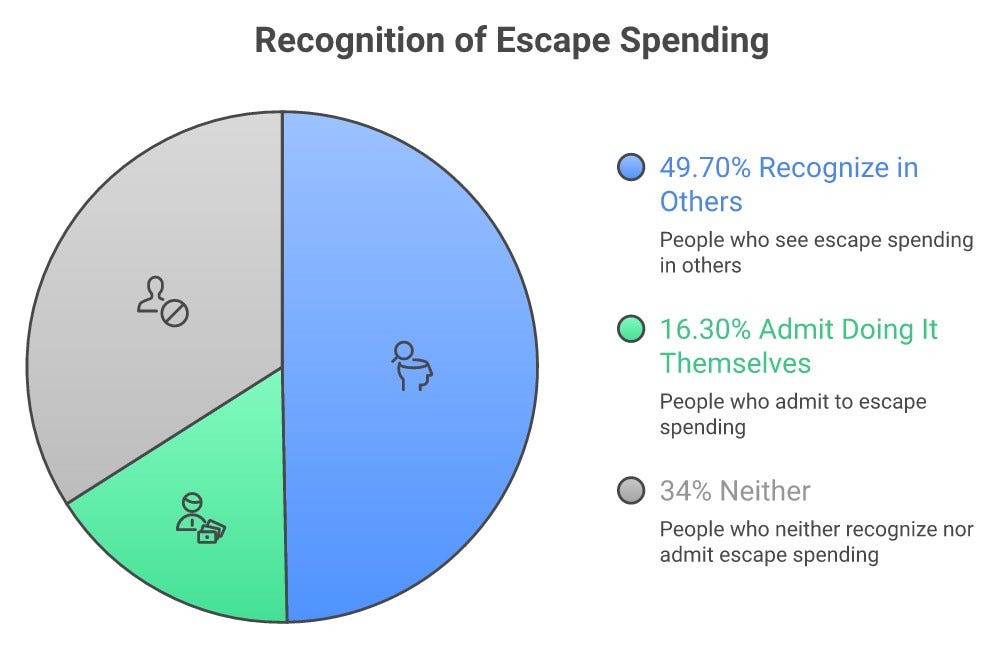
When we asked people if they’d ever noticed someone else using spending to escape emotional pain, 49.7% said yes — nearly half.
When we asked if they did it themselves? 16.3%.
Read those numbers again. Half of us can see it in the people around us. One in six can see it in the mirror.
That gap — between what we recognize in others and what we admit about ourselves — is where most debt lives. Not in the spreadsheet. Not in the budget app. In the blind spot.
I filed bankruptcy in 1990. My real estate business collapsed in an economic downturn, and I found myself drowning in debt I couldn’t service. And I can tell you from personal experience — the shame of that debt didn’t make me spend less. It made me spend differently. Escape spending doesn’t always look like shopping sprees. Sometimes it looks like the $14 lunch you “deserve” because the morning was brutal. The subscription you forgot to cancel because opening that app means confronting the number. The Amazon order at 11pm because today was a lot.
None of that shows up as a problem on a budget spreadsheet. It shows up six months later when the math is broken and you don’t know how it happened.
The financial industry’s answer to all of this is: try harder. Make a better budget. Use a different app. Cut the lattes.
That advice fails because it treats debt as a math problem. Debt is math — but it’s math wrapped in emotion. And you cannot spreadsheet your way out of an emotional pattern you can’t even see.
The actual research on what works looks nothing like what the gurus tell you. It’s not about expense tracking. It’s about emotion tracking — recognizing the trigger before the dopamine hits, sitting with it for 10 to 15 minutes while the urge passes, and understanding that the relief you’re chasing evaporates the moment the credit card clears.
45 to 50 percent of people who work on this with guided support achieve lasting change. That’s a real number from real clinical research. It’s not 100%. It’s not a miracle. But it’s a lot better than another budget that quietly makes you spend more.
I wrote the full breakdown of this — the brain chemistry, the research on what actually works, how Buy Now Pay Later is engineered to exploit these exact patterns, and what your real options are when the debt has already piled up.
Read the full piece on GetOutOfDebt.org →
If you know someone who’s been grinding on a budget for years and can’t figure out why it isn’t working — this might be the thing that finally explains it.
Steve
P.S. The title of that piece uses the word “addiction.” I use it carefully. Most people dealing with this don’t have a clinical disorder. They have a pattern they can’t see. That distinction matters — and it’s the reason the usual advice fails.