

By Steve Rhode, founder of GetOutOfDebt.org — helping people escape debt since 1994.
When I ran a credit counseling organization, we didn’t just help people with their debt. We studied them. We surveyed 1,000 adults — not people in financial trouble, just regular people — and asked them how they actually feel when they spend money.
What we found was fascinating.
40% said their mood changes before or after a purchase. Not their bank balance — their mood. 16% said they spend specifically to change how they feel. And 51% — more than half — said they’ve tried to control or cut back their spending and couldn’t.
That last number stopped me cold. Half of all adults have a relationship with spending that operates outside their conscious control. That’s not a character flaw. That’s human wiring.
In 1899, an economist named Thorstein Veblen published a study that the financial advice industry still hasn’t caught up with. He discovered that people will endure genuine hardship — real discomfort — before they’ll give up the appearance of doing well.
He called it conspicuous consumption. We call it normal life.
Think about the last time someone you know drove a car they probably couldn’t afford. Or posted a vacation they put on a credit card. The instinct isn’t to judge — it’s to recognize something deeply human. We are social animals, and money is how we signal where we belong.
Veblen figured this out 125 years ago. And yet every budget app on the market still assumes people are making rational decisions.
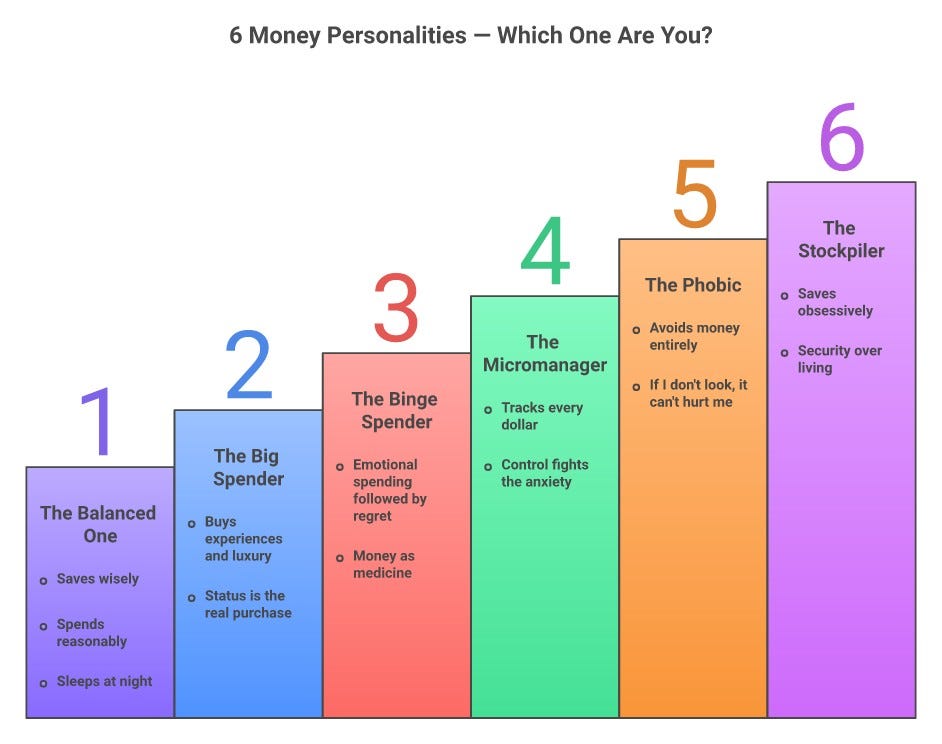
After 30 years of conversations about money, I’ve watched the same six patterns show up again and again. Not good or bad — just different ways people are wired to relate to money.
The Balanced One — saves wisely, spends reasonably, sleeps fine at night. They exist. They’re just not as common as the internet pretends.
The Big Spender — drawn to experiences, quality, the best version of everything. What’s really happening? They’re buying proof of arrival. Every purchase says “I made it.” It’s not vanity — it’s identity.
The Binge Spender — this is the most misunderstood one. They don’t lack willpower. Our research found that 25% of people use spending the way others use a glass of wine — to change how they feel. The purchase is the relief. The regret comes later. Then more spending to escape the regret. It’s a cycle, not a choice.
The Micromanager — knows where every dollar went. Checks accounts daily. Has spreadsheets with color coding. It looks like the “responsible” personality, but here’s the twist: for many of them, the tracking isn’t preventing anxiety. It IS the anxiety. Control is the coping mechanism.
The Phobic — won’t open the bills. Won’t check the balance. Avoids money conversations entirely. Most people assume this is laziness. It’s not. It’s the same instinct that makes someone close their eyes on a roller coaster. If they don’t see the number, it can’t hurt them. Financial avoidance is a stress response, and it’s far more common than anyone admits.
The Stockpiler — saves aggressively, avoids spending, finds security in the number going up. Society celebrates this one, but there’s a shadow side: they can accumulate a lifetime of savings and a lifetime of missed experiences at the same time.
Now here’s the part that makes this really interesting.
Look at those six personalities and think about the people in your life. A partner. Parents. A best friend. Most people can place each one in about three seconds.
And here’s the pattern researchers keep finding: opposites attract. Savers pair up with spenders. Micromanagers fall for Phobics. The Stockpiler marries the Big Spender.
It’s not a coincidence. People are drawn to what balances out what they’re missing.
The problem is, what attracted two people to each other becomes the thing they fight about. And the fight is never really about the electric bill or the Amazon order. It’s two completely different relationships with money colliding — and usually neither person understands their own relationship, let alone their partner’s.
Knowing that a partner is a Stockpiler because they grew up without financial security changes “why won’t they let us enjoy anything?” into “I understand why this matters to them.” That’s not a small shift. That’s everything.
I built a free quiz that identifies which of the six money personalities someone is. Fifteen questions, about three minutes, no email required — just an honest look at how a person actually relates to money.
Take the Money Personality Quiz →
Take it alone first. Then take it with someone you love.
The conversation that follows might be the most important money conversation two people have ever had — and it won’t involve a single number.
— Steve
P.S. If anyone wants to go deeper on any of this — their personality, their situation, their options — GetOutOfDebt.org is where I’ve been answering those questions since 1994. Always free.